
Pipeline Inline Inspection Services Built Around Your Line
A successful inline inspection involves more than selecting an ILI tool. Pipeline preparation, cleaning, tool speed, inspection technology, and data analysis can all affect the quality of the information operators receive.
Enduro brings these capabilities together to help operators prepare the pipeline, execute the inspection, and turn the resulting data into information they can use
From Pipeline Preparation to Actionable Data
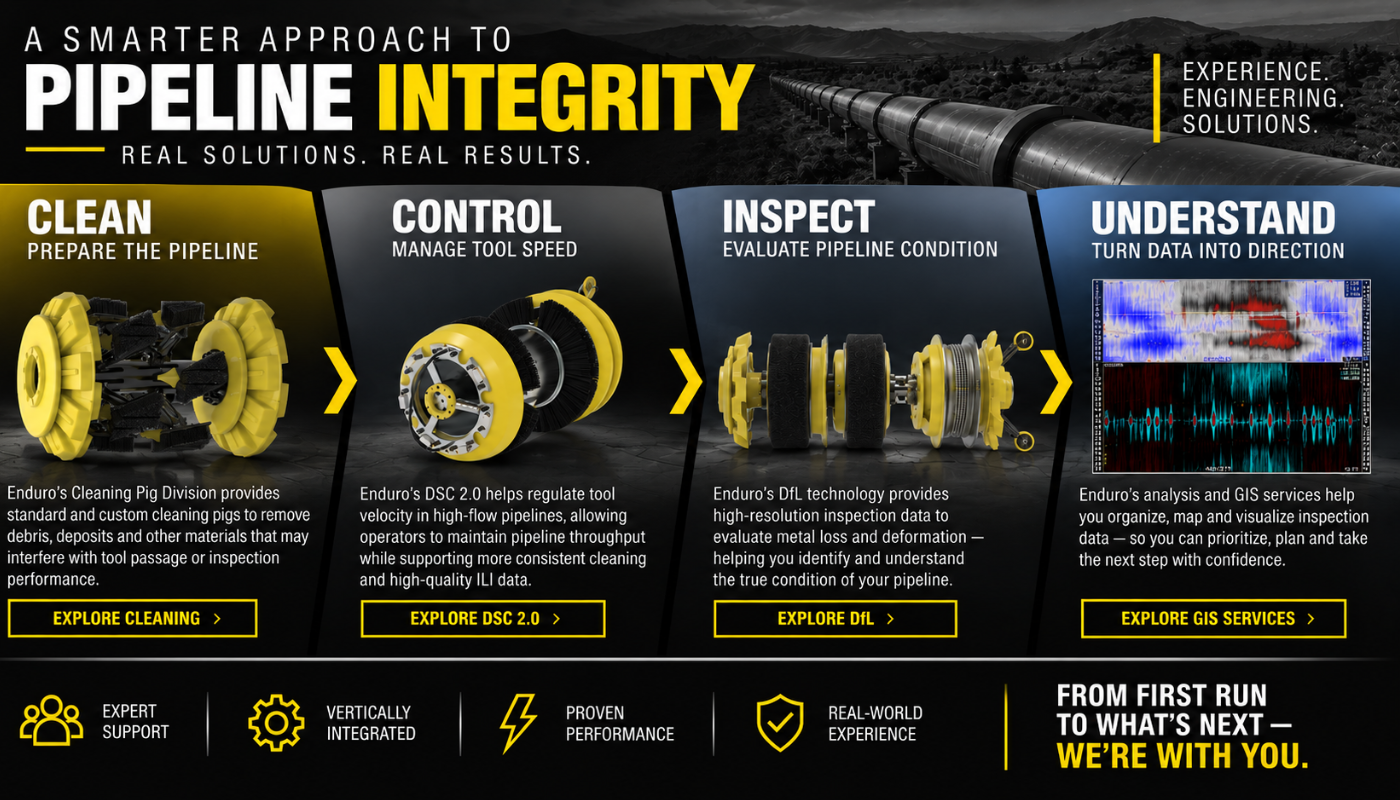
Inline inspection is a connected process. Pipeline conditions can affect tool performance. Tool velocity can influence inspection data quality. Inspection technology determines which conditions it can identify. The resulting data must be analyzed and understood before it can support integrity decisions.
Enduro supports those stages through four connected capabilities:
CLEAN → CONTROL → INSPECT → UNDERSTAND
CLEAN — Prepare the Pipeline
Enduro's Cleaning Pig Division provides standard and custom cleaning pigs to remove debris, deposits, and other materials that may interfere with tool passage or inspection performance.
CONTROL — Manage Tool Speed
For high-flow gas applications, DSC 2.0 helps regulate tool velocity while allowing operators to maintain pipeline throughput, supporting more consistent cleaning and ILI performance.
INSPECT — Evaluate Pipeline Condition
Select inspection technology based on what you need to understand. Enduro's DdL geometry tools identify deformation and changes in pipeline geometry, while MFL/DfL technologies evaluate metal-loss conditions.
Explore Inspection Technologies
UNDERSTAND — Put the Data to Work
Inspection doesn't end when the tool reaches the receiver. Enduro's analysis, mapping, and GIS capabilities help organize and visualize inspection information so operators can use the results to support integrity
Inspection Solutions Built for Real-World Conditions
- Ultra-High-Resolution MFL
Evaluate metal loss, corrosion, and pitting with high-resolution inspection data. - High-Accuracy Geometry (Caliper Tools)
Identify dents, wrinkles, ovality, restrictions, and other changes in pipeline geometry. - IMU & Mapping Integration
Connect reported features with positional information for improved location and correlation. - Inspection Data Analysis & Reporting
Fast, organized, and easy-to-interpret results so your team can move quickly.
Common Inline Inspection Challenges
Inline inspection operations can present several operational and integrity management challenges depending on pipeline conditions, product type, flow characteristics, and overall pipeline cleanliness.
Common inline inspection challenges may include:
• Excessive debris or contamination inside the pipeline
•
Wax or paraffin buildup
• Difficult geometry or diameter transitions
• Tool speed management concerns
• Tracking and location verification requirements
• Limited launcher and receiver accessibility
• Data quality impacts caused by inadequate cleaning
The right solution depends on the challenge. A debris problem may require additional cleaning. A high-flow gas application may require speed control. Geometry concerns may call for a caliper inspection, while suspected corrosion requires metal-loss inspection technology.
Enduro's team can help evaluate the pipeline and determine which combination of preparation, inspection, and support makes sense for the project.
You Don't Have to Start With an ILI Tool
Not sure whether the next step should be additional cleaning, a caliper inspection, MFL, speed control or something else?
Start with the pipeline.
Tell our team what you know about the line, what you've already done and what you're trying to learn. We'll help evaluate the application and determine an appropriate next step.
The goal isn't to use every Enduro capability. It's to use the right ones for your pipeline and inspection objective.
Inline Inspection Resources
Planning a successful inline inspection begins with understanding the pipeline, the threats being evaluated, and the technology needed to collect reliable data. Explore these resources to learn more about inspection preparation, tool selection, and data quality.
MFL-DfL Inline Inspection
Learn how high-resolution Magnetic Flux Leakage technology helps identify corrosion, pitting, metal loss, and other pipeline threats.
Caliper Inspection vs. MFL Inspection
Understand the difference between geometry and metal-loss inspections, what each technology identifies, and when operators may use both.
Compare Inspection Technologies
What Does a Caliper Inspection Detect?
Learn how caliper and geometry tools identify dents, ovality, wrinkles, restrictions, and other changes in pipeline shape.
Learn About Caliper Inspection
Pipeline Caliper Tools
Explore Enduro’s caliper and geometry inspection capabilities for evaluating pipeline deformation and confirming internal geometry.
Preparing for an Inline Inspection
Review the important steps operators should consider before launching an ILI tool, including pipeline conditions, cleaning, and run readiness.
Chris Hallam
Director of Business Development & Sales
chrish@enduropls.com
We get it. Sometimes you don’t want to make a call.
Drop us a few details—we’ll do the heavy lifting and follow up with a clear recommendation.
Complete our
quote form, and one of our experts will reach out to you.
Frequently Asked Questions
What inline inspection services does Enduro provide?
Enduro provides inline inspection solutions using high-resolution MFL, caliper and geometry, IMU, and mapping technologies. Available inspection options depend on pipeline conditions, inspection objectives, and the threats being evaluated.
What is the difference between MFL and caliper inspection?
MFL inspection is used to identify metal loss, corrosion, and pitting. Caliper and geometry inspections measure changes in pipeline shape, including dents, ovality, wrinkles, and restrictions. Operators may use both technologies when metal loss and deformation need to be evaluated.
How do I know which ILI technology my pipeline needs?
The appropriate technology depends on the pipeline, product, diameter, operating conditions, known concerns, and inspection objectives. Enduro’s team can review the application and help determine whether MFL, caliper, geometry, IMU, mapping, or a combination is appropriate.
Can Enduro help prepare a pipeline for inline inspection?
Yes. Enduro provides pipeline cleaning pigs, pre-ILI cleaning guidance, tracking equipment, inspection technologies, field support, and data analysis. Bringing these capabilities together can help operators prepare for and execute an inspection.
How do I request an inline inspection quote?
Provide the available pipeline information, including diameter, length, product, operating conditions, inspection objective, known concerns, and preferred schedule. Enduro’s inspection team will review the application and follow up to discuss the next steps.